Sadhana Panchakam – All Classes
Sadhana Panchakam was written by Ādi Śaṅkarācārya. Sometimes this is also called Sopana Panchakam or Upadesa Panchakam or Advaita Panchakam. The word Panchakam means a text consisting of five verses. It is called advaita panchakam because these verses deal with advaidic teaching contained in vedas. The word upadesa means teachings or instructions; Upadesa Panchakam means five verses dealing with the instructions. The teaching in these verses are given in a graded manner. Sopānam means a flight of steps. Like a flight of steps, instructions are given to reach the goal. These five verses deal with a series of sādhana-s or disciplines to be followed by every human being and that is why it is also called sadhana panchakam. Sādhanam means and sādhyam is end. The person who accomplishes the sādhana-s is called sādhaka.
A series of sādhana-s are given for two goals:
- Discovering what is the goal of human life.
- Accomplishment of the goal
Keeping these goals in mind, a scheme for life is presented. This scheme of life is given by vedas and scriptures. This is presented by Shankaracharya in five verses.
What is the scheme given by the Vedas? This scheme is known as varṇa āśrama vyavasthā; scheme of varnas and scheme of āśramas; varṇa vyavasthā means diving the whole society into four groups: brāhmaṇa, kṣatriya, vaiśya, śūdra-s. This classification is based on the contribution towards society. This classification was given by scriptures for social harmony and social growth.
The second scheme is āśrama vyavesthas or scheme of four stages of life. This scheme is presented for individual harmony and growth. In this work, Shankaracharya is primarily concerned about the āśrama vyavesthas. The four āśramas are:
- Brahmacarya: Student stage of life
- Gṛhastha: Householder stage of life
- Vānaprastha: Hermit stage of life
- Sannyāsa āśrama: Stage oof life as a monk
This scheme is almost gone and has only a skeletal existence. But internally and mentally everyone must through this scheme.
For all human beings, irrespective of varna or āśrama, the scriptures describe some common disciplines; universal disciplines; These disciplines are called sāmānya dharma; general disciplines and duties. These can be broadly classified into two: Avoidances (don’t) and the second consisting of pursuits (dos). Each one consists of five; five don’t disciplines are called Yama or nivruti and five do disciplines are called niyama or pravṛtti bodha.
Yamas: Five avoidances
- Ahiṁsā: Nonviolence; avoidance of harm to others by thought, word and deed.
- Satyaṁ: Do not speak untruth; do not lie; It does not mean you always tell truth; do not speak untruth; so, this is avoidance of lie. Either speak truth or observe silence, but do not speak untruth.
- Asteya: Don’t possess illegitimate wealth.
- Brahmacaryam: Avoidance of illegitimate sexual relationships.
- Aparigraha: Avoidance of possession of too much wealth, even though it is legal.
Five Niyama: Disciplines to be pursued.
- Śauca: Purity; positively working for physical purity and mental purity.
- Santoṣa: Positively developing a sense of contentment.
- Tapas: Willful self-denial; to avoid slavery to our organs.
- Svādhyāya: The study of scriptures; with or without knowing meaning.
- Īśvara Praṇidhāna: Worship of the lord.
Viśeṣa Dharmas (specific disciplines) are not universal but should be followed by segments of society. These vishesha dharmas are based on varna and āśrama designation of a person. They are known as varnāśrama dharma or vishesha dharma or svadharma. Shankaracharya does not discuss sāmānya dharmas and prescribes vishesha dharmas at four stages of life.
The first stage is Brahmacarya āśrama – a student’s life where a person is supposed to study vedic scheme of life. There was 12 years of study. First, he learns what should and should not do in each āśrama. Only after this study, can a student be called brahmachary. Brahma means veda and chary means the one who follows the discipline of studies. This is the first stage: being aware of the vedic grand design.
The second stage is gragasthasrama in which one takes the life of activity as prescribed for his particular varna. This is predominantly discussed in the first portion of vedas or karma kāṇḍa; When a person follows this discipline, a person gets mental purity. Freedom from raga dwesha; likes and dislikes, because of which a person is generally disturbed. This indicates equanimity of mind or samatvam or chithasudhhi.
Third stage is vanaprastha āśrama; here extrovert physical activities are reduced, and mental disciplines are increased in the form of upāsanās. This is discussed in the second portion of vedas or called upāsanā kanda. A person may leave his house at this stage or may chose to stay in the house, withdrawing from life and daily activities. This gives a focusing faculty or converging faculty.
The fourth and final stage is sanyasa āśrama in which a person is free from all psychological dependences and attachments. If this is done physically then, he is an external sanyasi. If it is done mentally, then he is internal sanyasi. This is the final discipline or Jñāna yoga or pursuit of spiritual knowledge, which corresponds to Jñāna kanda portion of vedas. By following this, a person becomes Jñāni. He becomes jīvanmukta, the one who has discovered inner freedom or liberation.
In the first sloka, we get first two stages. In the second and third slokas we get third and fourth stages. In the fourth and fifth Shankaracharya gives general instructions to be followed.
Śloka 1
The scriptures should be regularly studied by you. This is done in the first stage of Brahmacaryam and continued in the other āśramas. First, vedas are chanted then the meaning is studied and understood. Adhyayanam is chanting and mīmāṁsā means understanding the meaning. To understand the meaning of the vedas, one must know certain auxiliary sciences knowns as veda angaṉi. If you want to understand physics, you must know mathematics. In brahmacharya āśrama the student learns veda anga also. It is not mere technical expertise; he should know what to do when he comes out of this āśrama. He must have clear cut understanding of his goal and also how to conduct himself in society. When life presents challenges, how to deal with them? In Brahmacarya Ashram, he studies the art of living and conducting in society, in addition to learning their profession.
Class 2
Sankarachariyar is discussing the grand scheme of āśrama avastha – the four stages of life. The first stage is called Brahmacaryam where a student learns chanting of vedas, learns auxiliary sciences veda anga vichara and veda artha or mīmāṁsā. If he is shathriya he learns dhanu sasthram, if he is Vaishnava he learns vedic studies.
Having understood the scheme in Brahmacaryam, one has to go to the next stage gragasthasrama where he implements the scheme.
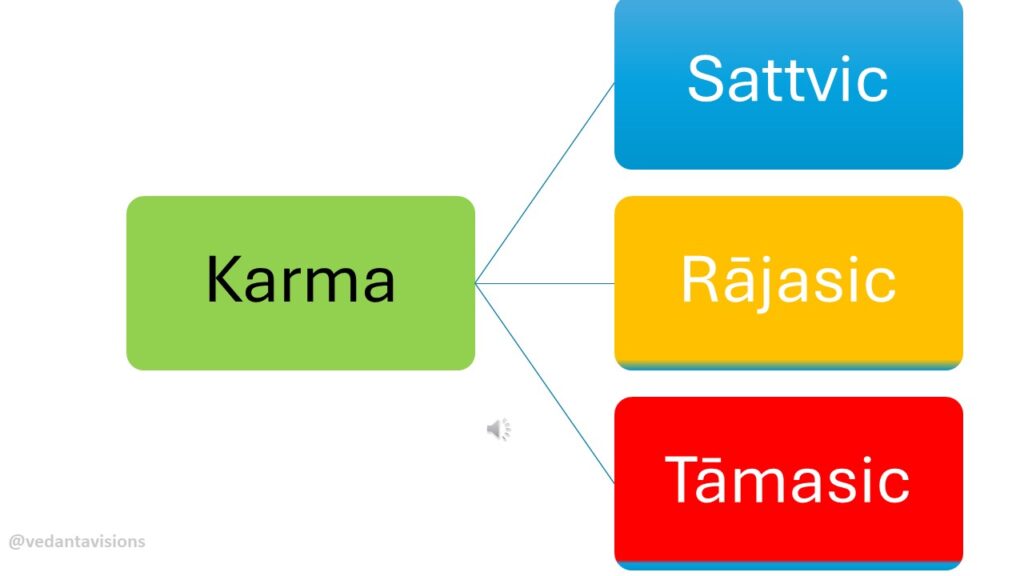
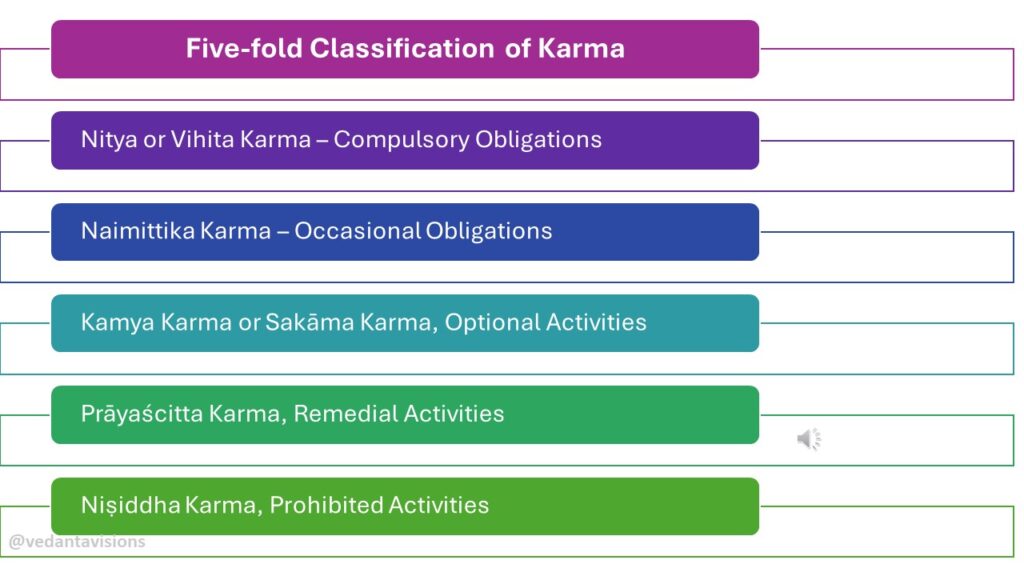
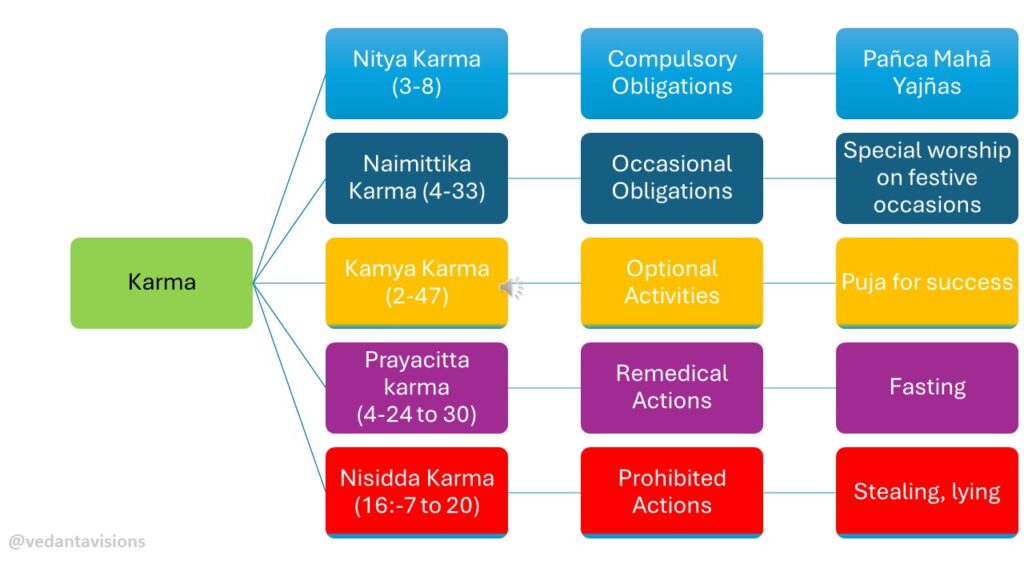
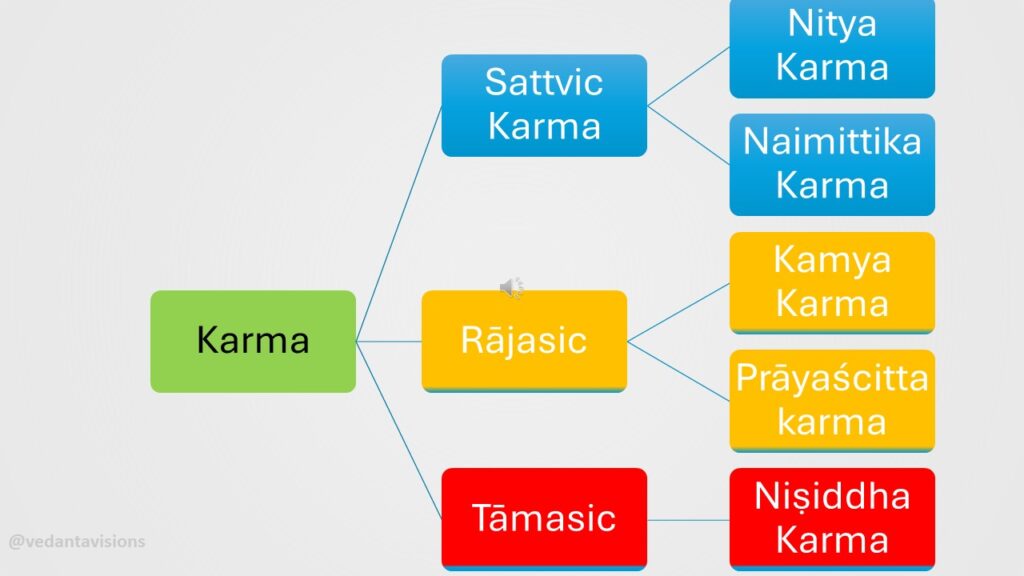
The first stage is karma anushtanam, following the karmas prescribed in the vedas. The ten sāmānya dharmas should be implemented by all – the five do’s and don’ts – Yama: Five values ahimsa, Satyaṁ, astheyam (not owning any illegitimate property), brahmachariyam and aparigragha (not possessing too much) and Niyama: Soucham (Cleanlienss), santhosha (Contentment), tapa (moderation in everything), swadhyaha and Īśvara pranidhanam. yama. In addition to these universal values, one has to follow vishesha dharma or specific duties which is called svadharma which will vary from brāhmaṇa to shathriya, shathriya to vaishya etc. This karma or the vedic duties can be classified into three:
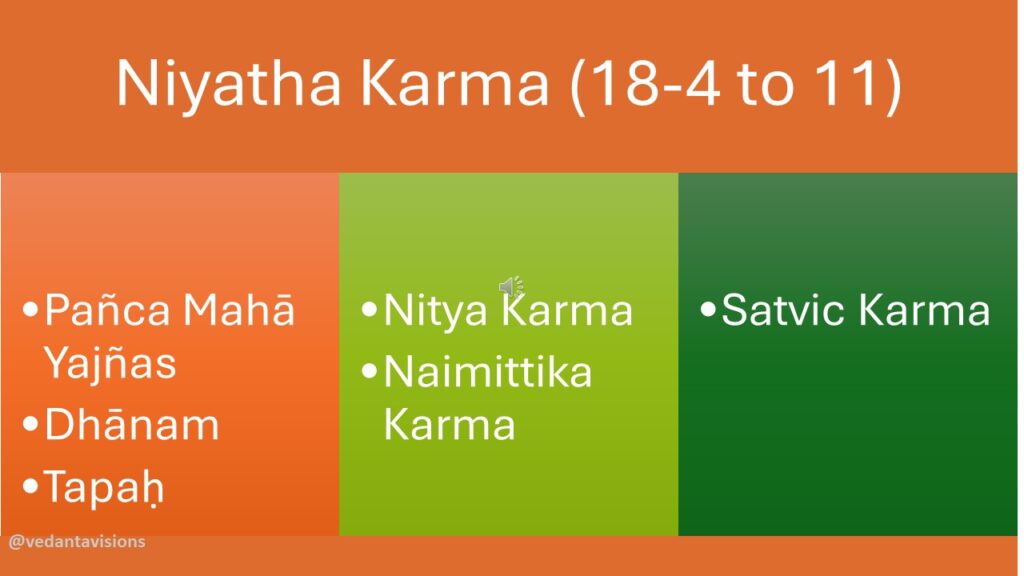
- Niṣkāma karma: Those compulsory actions which do not depend on your like and dislikes. These are based on vedic commandments and are meant for spiritual growth and refinement of mind.
- Sakama Karma: These are based on our desires; they are not compulsory and are optional. These are meant for material well-being.
- Niṣiddha karma: These are prohibited karmas and must be renounced; like harming, telling lies etc. These are obstacles to spiritual growth.
Do the niṣkāma karma properly without fail. Lord Krishna uses the word svadharma throughout Bhagavad Gītā. In the scriptures, the svadharma is determined by varna and āśrama. However, the varna and āśramas are not alive today. So, we need to interpret svadharma with present day need. This should be practicable by all. This is panca mahā yagya, which is svadharma of all people.
- Deva Yajña: Worship of the lord. Just offering flowers, chanting slokas, going to pujas etc. It does not matter what way you worship, but it must be done. If this is done for material benefit, then it will not be niṣkāma karma, but it will be sakama karma.
- Pitṛ Yajña: Worship of forefathers; Vedas have prescribed certain rites; it doesn’t matter how we express our gratitude towards forefather, but it must be expressed.
- Brahma Yajña: Worship of vedas and rishis, in the form of ritual. We do our best to preserve and propagate the scriptures.
- Manuṣya yagya: We are indebted to every other human being. All we use and consume is because somebody has worked and is working; therefore, I am indebted to entire humanity. One of the best manuṣya yagya is anna dhānam. All social services will come under manuṣya yagya.
- Bhūta Yajña: Worship of so-called inferior living beings; animals and plants. Feeding the animals, insects and birds is bhudha yagya. Offering of worship includes worshipping forefathers, rishis, animals, plants etc. Only when this is included, puja is puja.
What are sakama karma? Sakama karma are actions for material wealth. May you gradually give up actions meant for material wealth – artha kama. In those days, everyone did their duty (svadharma), whatever the other person voluntarily gives, they lived on that. When everybody does their svadharma, it works. However, now svadharma based society is gone and payment-based society is evolving. Everybody’s svadharma became automatic payment of other’s svadharma. Lord Krishna says gradually reduce kamya karma. How do you reduce kamya karma?
Kamya karma increases because of the increase of raga dwesha. As the kama increases, kamya karma increases. As we reduce raga dwesha, kamya karma will also be reduced. Svadharma anushtanam will reduce kamya raga dwesha. Raga dwesha is called pāpam because whatever obstructs spirituality is pāpam. Raga dwesha obstructs spirituality, therefore raga dwesha is pāpam. Raga dwesha makes mind extroverted. This bundle of raga dwesha should be neutralized. May you repeatedly see the following three defects of worldly accomplishments, worldly pleasures:
- It is mixed with pain, pain in acquisition, maintenance and departure.
- It will never give satisfaction, the more I have, the more I want.
- They make a person a slave to them, we will get addicted to them.
Through the refined mind, one can discern the defects and become viveka or mature. Eventually kamya karma will become less and less. It is not enough that we just understand this, we should also remember this all the time.
If all material benefits are defective, is there a defect free ānanda? The answer is atma; Atmānanda, is free from all the three defects. Turn the direction from material pleasures to spiritual fulfilment.
Class 3
Sankarachariyar is dealing with the second stage of life; the first stage of life is learning about the way of life I should be leading. Having learnt that in the first stage of brahmachariya āśrama, one has to go to the next stage of gragasthasrama, one should implement the svadharma learnt from sasthra. In the case of brahma jñānam, jñānam itself gives moksha. In this case knowledge itself is an end itself. In the case of dharma jñānam, knowledge itself is not an end itself, but it must be followed by implementation and application. The key in gragasthasrama is svadharma anustashanam. Svadharma in modern times is panca mahā yagya. Vedas do not clearly tell what the benefit of svadharma is. Svadharma is presented for material benefits by the Vedas; however, Veda’s intended benefit is we should develop spirituality and our crave for materialism should subside. Vedanta is not against using material benefits but does not want us to lean on material benefits. Turning away from anithyam and turning towards nithyam is the aim of Vedas. Turning away from anatma and turning towards atma is the aim of the Vedas. A person is not mature enough to know the value of moksha and therefore Vedas presented svadharma as a way to prosper. Even though the explicit benefit is material prosperity, the intended benefit is spiritual inclination. The svadharma will make the mind see the limitation of material accomplishment; we do not hate material benefits, but we refuse to lean up on them. There is only one secure thing in the world; all others are insecure and not worth leaning on.
Viveka, vairāgyam and mumukṣutvaṁ are all implied in the first verse. Once these three qualifications are acquired, one has successfully gone through the second stage of gragasthasrama. After this, one should get out gragasthasrama and get to vanaprastha ashram. This means, karma should be reduced and replaced by more time devoted to upāsanā or meditation. In gragasthasrama, because of too many duties, mind has become highly extroverted. In gragasthasrama, karma is more and upāsanā is less. In vanaprastha āśrama, upāsanā is more and karma is less. For current times, one can stay in home but increase the time spent on upāsanā and reduce time spent on worldly activities.
Verse 2
In vanaprastha āśrama, one must be obsessed with spiritual pursuit; one must have satsanga or association with spiritual seekers or wisemen as much as possible. Materialistic arguments are so powerful, one can easily fall prey to them. Until you are firmly established, be selective with your friends, books etc. The primary function in vanaprastha is bhakti or upāsanā or meditation of the lord or the Virāṭ svarūpa. Upasana and yoga shastra go together. Patanjali’s aṣṭāṅga yoga is good for integrating personality in life:
- Yama and niyama; these two will help in integration our way life.
- Asana will integrate my annamya kosa and discipline my physical body.
- Pranayama will integrate with pranayama kosa or breathing discipline.
- Prathyagra integration of sense organs.
- Dharana, Dhyana and Samadhi: these three will help integration of mind.
In the vedanta sasthram, instead of focusing or various chakras of body, we focus on brahman. By the practice of upāsanā and yoga one should develop one more faculty that is samadhi shadka saṃpatti or six-fold inner wealth:
- Samaha or thought discipline; reducing thoughts occurring without my knowledge; not stopping the thought but the capacity to channelize the thought in the direction we want. All the alues will come under this concept. Daivi sampat and asuri sampat will come under this.
- Dhamaha or sense discipline; Sense organs functioning as I want and not as it wants. Real mastery is not over other people, but mastery over sense organs.
- Uparamaḥ or withdrawn mind; mind withdrawn from unwanted field should not run again towards to the unwanted field. Withdrawing mind is samaha and restraining the mind is uparamaḥ.
- Titikṣā or inner strength to face difficult times; forbearance; there are certain inevitable opposite like heat and cold, arrival and departure; jenma and marana; sukam and duḥkam; capacity to withstand these is titikṣā.
- Shradha or faith in the scriptures and the teacher. It is not blind faith; if there is doubt, then I inquire until I am satisfied.
- Samādhānam or concentration; non wavering mind; in yoga sasthra it is called samadhi.
May all karma and upāsanā be totally given up because they have served their purpose. Karma and upāsanās are like womb; they are relevant only until Sadhana Catuṣṭaya Saṃpatti ripening. Once Sadhana Catuṣṭaya Saṃpatti is completely assimilated karmas and upāsanās should be renounced. This is also the formal process of entering into sanyasa āśrama. If the person does not have inner attachment, even the house can be sanyasa āśrama. The sign of detachment is that I am prepared to lose anything around me. If karma and upāsanās can’t be performed then take to Jñāna yoga, corresponding to Jñāna kanda. Take up Sravanam, Mananam and nidhithyasanam.
Class 4
Sankarachariyar talked about the first three stages, karma yoga and upāsanā which are to be practiced in the first three āśramas. Once the person has successfully gone through the first three stages, then he is ready for Jñāna yoga which is generally pursued in sanyasa āśrama. Whether a person physically renounces or not is not the question. A mind with a renunciation is ready for final sadhana which is Jñāna yoga.
First Sankarachariyar wants to emphasize that Jñānam must be pursued under the guidance of a guru alone. Knowledge without a guru will give information but not transformation. To learn anything, we go to a teacher. We do accept exceptions to any rule and if there is anyone who becomes a Jñāni without a guru, that is an exception and not the rule. Even if one gets knowledge without a teacher, we can accomplish the same thing faster with a teacher. Two meanings of this verse:
- May you approach a brahma Jñāni.
- May you approach a competent Jñāni. We should approach a Jñāni who has been a disciple of a guru, who has not studied independently. This guru knows the traditional methods of teaching and communication.
If we are approaching a vidwan and gain knowledge, that person must be alive. Other mahatmas can be kept for inspiration and worship; for learning we require a live teacher.
Why should we worship a teacher, a human being? First, it helps weaken our ego. Secondly, the scriptures are not going to speak to us directly. Upanishads themselves do not speak to us and we get the upaniṣad teachings from the guru. For the students, the guru is sasthram. We must develop as much faith in the guru as much faith he has with the sasthram. Physical actions like puja, namaskara etc. create an inner attitude of divinity.
Once the rapport has been created and the channels have been opened, we may ask for brahma knowledge. In this context, Brahman should be understood as brahma jñānam. Jñāna yoga consists of a threefold process of sravanam, mananam and nidhithyasanam.
Systematic, consistent study for a length of time is sravanam. Systematic Study consists of:
- Analysis of jivatma; anvaya vrithireka method, to find out the essential nature. Whatever feature is there all the time that is my essential nature and permanent nature. Whatever feature is incidental feature is temporary. Example is hot water; heat is not the essential nature of water; but fire has heat as the essential nature. So, heat is the incidental nature of water and essential nature of fire. Based on this, chit or awareness is the only essential nature of jivatma.
- Analysis of paramatma; macrocosm by the method of adhyaropa apavara; through this analysis we come to the essential nature of totality, which is sat or pure existence. The permanent and changeless nature of creation. Everything else is subject to change.
- Then come to the mahā vakya tat tvam asi; pure existence and pure consciousness are one and same.
Verse 3
Here Sankarachariyar briefly mentions sravanam, mananam and nidhithyasanam. The upaniṣad vakyam does not convey the teaching explicitly or directly. Mimamsa sasthram is the key to fully unlocking the meaning of vedanta. Without mīmāṁsā, vedas will appear abstract and contradictory.
In Kaivalya Upanishad, in one verse the Upanishad says from Brahman the panca buddha, jnaendrya, karmendria are all born. (Around 12th or 13th verse). Since all these are born from Brahman, Brahman is nirgunam and therefore, they are not there. These two statements are contradictory.
In Taittariya Upanishad, the mantra says Satyaṁ, jñānam and ānandam. In the beginning it said Brahman is all pervading but now it says it entered everything. These two are contradictory. In mīmāṁsā method, when a sentence is not clear, you do not go deep into the statement. You arrive at the proper meaning by considering all other statements made by the Upanishads. Then we will find the beautiful meaning conveyed by the statement. Six factors of mīmāṁsā (shad lingam) are used to tie together all the Upanishad statements and arrive at the true meaning. This is sravanam and by this you arrive at the conclusion that essence of jivatma is chit, essence of paramatma is sat. And paramatma and jivatma are one and the same. Aham Brahma Asmi.
Note regarding mīmāṁsā:
Swamiji referred to six factors or Shadanga are:
- Shabda (Word): Shabda refers to the words of the Vedic text, which are considered to be the ultimate authority. Mimamsa emphasizes the importance of analyzing and understanding the precise meaning of each word in the text.
- Artha (Meaning): Artha refers to the meaning of the words in the Vedic text. Mimamsa believes that the true meaning of the text can only be understood by analyzing the words and their meanings in great detail.
- Prayojana (Purpose): Prayojana refers to the purpose or goal of the Vedic text. Mimamsa emphasizes the importance of understanding the context and purpose of each text in order to properly interpret it.
- Dosha (Fault): Dosha refers to any faults or contradictions in the Vedic text. Mimamsa believes that these faults must be identified and resolved in order to properly understand the text.
- Samkhya (Inference): Samkhya refers to the process of inference or logical deduction. Mimamsa uses inference to draw conclusions and establish the meaning of the text.
- Upapatti (Example): Upapatti refers to the use of examples to clarify the meaning of the text. Mimamsa believes that examples can help to illustrate complex ideas and make them easier to understand.
Class 5
Shankaracharya is discussing final stages of Jñāna yoga – sravanam, mananam, and nidhithyasanam. Sravanam is nothing but systematic analysis of upaniṣadic statement. It is called vedanta vichara, vedanta mīmāṁsā etc. Through systematic analysis we discover consciousness is the essence of individuals, and existence is the essence of the world; consciousness and existence are one and the same. This we call sat chit atma. Consciousness is called sat and existence is called chit. This alone we call jivatma paramatma aikyam. This is sravanam.
Mananam is logically refuting all other systems which are contrary to vedantic teaching. Any knowledge involves two parts; one is seeing the rightness of the right part; second is seeing the wrongness of the wrong part. It is not enough to see the right alone; we also need to see the wrongness of wrong idea; if we don’t, one day the wrong idea may appear right. Knowledge is knowledge only when it can’t be shaken by anybody. I should know truth as truth and non-truth as non-truth. For opinions we can have variety, but for knowledge we can’t have variety. Rope is rope and it is not a snake.
Vedanta makes statement regarding three fundamental things: Jiva, jagat and Īśvara. First it says jiva is infinite and ānanda swaroopam. This we are not able to accept. Then it makes the statement about the world that the world is unreal. I am solidly facing the world all the time. How can I dismiss this wonderful solid universe? The third statement says that you are not different than the lord. This, I can’t accept at all. When we are in such despair, other systems will be easily acceptable. Other systems say jivatma is different than paramatma. Paramatma created the universe and jivatma. All other systems are very appealing to intellect. They all claim that they are rational systems based on logic and reasoning. Advaitam is based on sruthi, the vedas and use tarka or logic as a subservient tool. That is why we say shraddha in sruthi is important and required. A rational person will not accept faith. Their order is reason and scripture. Our order is scripture and reason. Mananam is where every other system is clearly negated. That can be done only with logic. Acharyas of advaitam have logically pointed out the logical contradictions in other systems.
Shankaracharya establishes that logic can’t be used in the discovery of reality because logic has intrinsic limitations. Logic and modern science etc. are deficient in discovering reality. Sruthi itself has said this limitation. This logical repudiation of other systems and seeing innate deficiency of logic alone increase our faith in vedanta.
If logic is deficient and can’t reveal the truth, does it mean logic should be totally given up? Sankarachariyar says logic does not need to be given up totally but used as a tool to extract the meaning of sasthra. Don’t use logic to invent a philosophy but use it to bring out the teaching of sasthra. This is called sruthi madha tarkakas. For all our questions and doubts, vedas does not give explicit answer. But at the same time, answers are hidden in vedas. We have to bring out the answer to remove my particular doubt. The method used for this is logic. Logic will be helpful in bringing out implicit answers. Many systems of philosophies were not there at Sankarachariyar time, so he did not repudiate those systems. Later acharyas repudiate those systems based on vedas, using Shankaracharya’s method. Answering all my doubts is mananam. The benefit of mananam is conviction in vedantic teachings. I can say “Aham Brahma Asmi” without any doubt. That is a knowledge with conviction.
The final stage of sadhana is nidhithyasanam. Nidhithyasanam is a process by which the knowledge has to be converted into emotional, mental and psychological strength. Our original decease is ignorance, which is at the intellect, but the symptoms are expressed at mental level in the form of kama, raga, dvesha, lōbha etc. All the samsara is at emotional level, but the root cause is at the intellect level. Initially, the solution is at the intellectual level. But it is not enough. I am convinced I am brahma asmi, but the symptoms of raga dwesha etc. must be totally rooted out. If not, the knowledge is as good as no knowledge and being ignorant. A vedanta does not help me in gaining calm, compassionate, considerate, generous, charitable mind – for that vedanta is utterly useless. This requires assimilation of teaching. The knowledge coming at the emotional level as emotional strength, duty and refinement. This is called jivan mukthi. Knowledge is at the intellectual level, but the benefit is at emotional level. Assimilating vedanta requires effort and requires removing each weakness. Assimilating food is a natural process but assimilating vedanta is a lifelong painful process. It is a lifelong process of consciously addressing and removing every emotional weakness. The weakness is different for each person. For one it may be a superiority complex and another it may be inferiority complex. Each of them should be removed. This is nidhithyasanam and it requires time and constant alertness to discover the weakness. For this introspect is required to gain auto suggestions when the weakness appear on day to day life.
We should look at what I am (Brahman) and what I am not (śarīra thrayâṃ). I should be able to see my own body as one of the objects of the world. We should have the same objective attitude towards our body as well as the bodies of the ones we love. Then the knowledge will be steady and firm. Cultivate I am brahman notion and negate I am body notion. This is nidhithyasanam and it requires lifelong commitment.
Sankarachariyar gives general instructions on how to live and they are conducive to nidhithyasanam. These instructions assume a person is at the stage of sanyasi. We will modify it to fit everyone:
- Make sure you don’t become arrogant because of this knowledge. Constantly remove the arrogance. Always be humble.
- Never argue with wise people.
Class 6
Having discussed sravanam and mananam part of Jñāna yoga, Sankarachariyar is discussing nidhithyasanam which is meant to convert the knowledge into emotional strength. This is meant for Jñāna nishta. Nidhithyasanam is of two types:
- Withdrawing from all vyākara and dwelling up on vedic teaching. This is sitting nidhithyasanam, withdrawing from all transactions.
- Always being alert in my day-to-day transactions. Being alert in my response to various situations, in the language I use in my transactions. Making sure that all my transactions are in keeping with vedantic teaching and not contrary to vedantic teaching. This alert life itself is a nidhithyasanam and is as important as the sitting nidhithyasanam. This is not confined to a particular time; it is through all my waking time.
When a person takes to nidhithyasanam, Sankarachariyar wants that person to note certain points. These are all values to be followed even before coming to Jñānam and values to be followed for before gaining Jñānam. First, I follow them for jñānam and thereafter I follow them for nishta.
- Be humble; amanithyam; make sure you don’t become arrogant because of this knowledge. Constantly remove the arrogance.
- Never argue with anyone, especially wise people. Because arguments can boost the ego. Also, we lose the opportunity to learn from wise people. Here we should make the distinction between vadhaha and samvadhaha (student clarifying doubts with a teacher). How do we distinguish between the two? There are many differences between vadha (arguing) and samvadha (questioning):
- When I argue with someone I look up on that person as equal or inferior to me. Whereas in samvadha, aspects’t look up on my teacher as superior to me, in knowledge, in maturity and in all aspect. There is a basic difference in attitude. This attitude is expressed by the very language and tone I use.
- Often when I enter into an argument, I have made a conclusion on the topic. Through argument I want to either establish my conclusion or refute the other person’s conclusion. Whereas in a student’s approach, the student has never made a conclusion. His aim is not to establish his conclusion or refute teacher’s conclusion; he just wants to learn. In one the mind is closed because the conclusion is already made, in the other the mind is open because conclusion is not made.
- In argument, I try to talk more and more, and I don’t allow the other person to talk at all. Even if the other person talks, I don’t listen, and I interfere before he has concluded. Whereas the student talks the minimum; he wants to put his idea to minimum and he wants the teacher to talk more and more; when the teacher talks, he listens attentively and does not interfere.
- In argument, since I have not listened to the other person, I have nothing to reflect upon. Whereas I am listening to the teacher, I work on what I listened to.
- There is a possibility that even after elaborate explanation, I am not convinced of teacher’s conclusion. Politely I ask once more, and teacher explains once more and I am still not convinced. I put off further questioning and think over the answers given. After giving enough time, I can raise the question. Whereas in argument, repeatedly arguing the same thing.
- After samvadha, there is no disturbance or bitterness in the mind, whereas after argument there is always bitterness and disturbance in the mind.
Verse 6
Food is required for all states. Sankarachariyar discusses food for sanyasi, because grihastha gets food at home. He discusses food as though it is a disease. Hunger is also some kind of disease because you are not at ease:
- For disease there is a remedy in the form of medicine; for hunger there is a remedy in the form of food.
- When you take medicine, the aim is only to cure the disease. It is taken only when there is disease and only as much is required to remove the disease. In the same way, you must take food, only when there is hunger.
- Since I am taking the medicine only to remove the disease, I am not particular about the taste of the medicine. Likewise, the likes and dislikes of food should not be important.
So, you should treat the disease of hunger regularly. But you should not ask for delicious food, because it identifies with your tongue and results in you identifying with the sthūla śarīram. Put up with the opposite experiences like heat and cold which are dependent up on desa, kala and prarabtha. These are the instructions for eating tongue. Now he gives instructions for talking tongue:
- Do not utter single word when it is not necessary to talk. Every word is spoken only after a well processed, well thought out and well monitored. All spiritual sādhana-s begin with tongue – both the eating and the talking tongue.
- Even if you want to say something, make sure the other person has respect for your words and whether he wants your advice. Ensure that the other person values your advice. Example: Krishna advised Arjuna only after Arjuna requires it, Krishna starts Bhagavat Gita only in second chapter.
- Don’t join any group and have only good words for everyone. Everyone has good and bad parts, and I only talk about the good words for everyone, otherwise I observe silence.
- Some people may be good to you and another set of people may be cruel to you. But don’t develop raga because they are nice to and don’t develop dwesha because they are not nice to you. Don’t let their behavior generate raga or dwesha. Let their behavior be forgotten right then there. If they ill treat you, forgive them and forget. If they praise you, thank them, thank the lord and forget.
Verse 5
In previous verses Shankaracharya give supportive sādhana-s for nidhithyasanam. The primary sadhana is dwelling up on the teaching. If we follow these supportive sādhana-s, mind will remain tranquil and ready for primary sadhana. Sit in a quiet place, fix your mind up on the supreme Brahman. See that Brahman none other than poorna atma, the primary illuminator.
Class 7
Shankaracharya is discussing the last stage of Jñāna yoga namely, Nidhithyasanam. Nidhithyasanam is of two types:
- One is withdrawing all transactions and dwelling up on the teachings of Upanishads, especially those aspects which are very relevant to me.
- The second type of nidhithyasanam is constantly alert through all my transactions so that my responses and reactions are not contrary to vedantic teaching.
The Fourth mantra gives instructions for nidhithyasanam; these instructions promote nidhithyasanam. In the fifth mantra, Sankarachariyar is talking about nidhithyasanam itself. Seated in a secular place, mind fixed up on brahman or atma, very clearly see the fact that atma is ever poorna; I don’t lack anything in life; I am self-sufficient. However, as long as the anatma world is there, atma can’t be poorna. As long as I see anatma as different from me, I the atma will be limited. Sankarachariyar says that may you negate anatma (the world) in the vision of atma. How is it possible? By seeing atma as karanam, sathyam and seeing anatma as karyam mithya. Anatma is taken as solid reality until I discover atma; in the discovery of atma, anatma is reduced to nama roopa. This world is negated with the vision of atma. Once a person has pursued nidhithyasanam for sufficient amount of time, jñāna nishta comes. Once jñāna nishta has come, this vision is spontaneous. No effort or will is required. This is called jivan mukthi. Once this spontaneous has come, even nidhithyasanam is not required. Until this spontaneous is achieved, nidhithyasanam is required.
Lead a life of jīvanmukta and at the time of death become videha muktha. But to understand jivan mutha and videha muktha, Sankarachariyar introduces the threefold karma: Sanjitha karma, agami karma and prarabtha karma.
Principles constitute the laws of karma:
- Every action has two types of results known as dhrishtam (visible result) and adhristham (invisible result).
- The invisible result is of two types: punyam and pāpam.
- Which action produces punyam and which action produces pāpam is determined by sasthram. Whatever actions commanded by sasthram produce punyam and whatever action prohibited by sasthram produce pāpam.
- The invisible punyam and pāpam will later give pleasurable and painful experiences.
- The gap or the duration required for punyam to produce pleasure is unpredictable by us. The punyam’s incubation period is inherent in punyam itself. Similarly, the incubation period of pāpam is also not predictable by us. This is like different seeds sprouting after different duration times.
- Since the time taken can’t be predicted by us, some of the punya pāpam may not fructify in this jenma because of which an individual dies with punya pava balance.
- To experience the balance punya pvam one requires punar jenma. In the next jenma, even though we exhaust some of the pava punya, we accumulate more punya pāpam. In next jenma more punya pāpam. Thus, every jiva has huge stock of pava paunya accumulated in the past countless jenma.
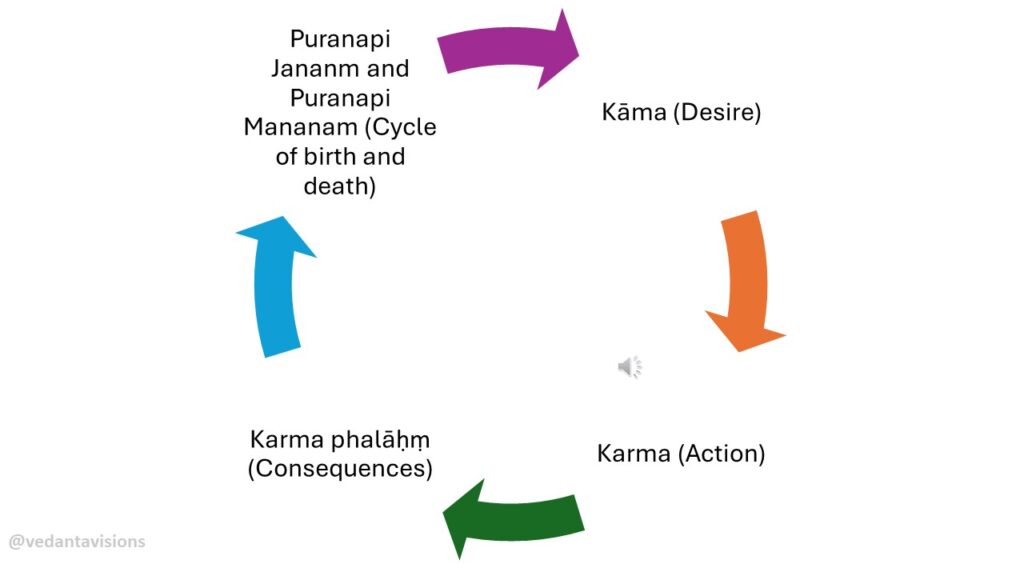
All the accumulated punya pāpam are called sanjitha karma. Out of this sanjitha karma, only a portion is ready for fruitification. That portion is called prarbtha punya pāpam, which alone is responsible for present birth, condition of present body, duration of life etc. When we are exhausting the prarbthamm in the current jenma, whatever fresh punya pāpam we acquire is called agami. In the agami also, some portions may fructify in this jenma itself. Some of the agami karma do not fructify in this jenma and they will join the sanjitha karma at the time of death. This sanjitha karma will result in the next jenma. This the cycle of an ignorant man.
This law of karma is not proven by science. Laws of karma are accepted by us based on sasthra alone. The benefit of accepting this law of karma is:
- The law of karma alone explains the disparity in the world, disparity among human beings. The law of karma explains the difference in human beings, animals etc.
- The law of karma helps in accepting some of the painful experiences for which we don’t see any immediate reason. The effect is visible, but the cause is not visible; but it is in the form of prarabtha pāpam; therefore, we don’t see the injustice in my suffering. I accept that I am suffering because of my past pāpam. The law of karma is a great shock absorber.
- If I accept the law of karma, I can take charge of my future. Because I know I am responsible for my current condition because of my past action. I alone is responsible for future conditions because of my current action. My future is not determined by fate, chance, or God, but it is determined by me. The present me is the product of the past me and future me is the product of current me. Therefore, I can take charge of the future. If the law of karma is not accepted, then everything is determined by chance, then the future is also determined by chance. Then why should I work for a better future?
- We can introduce moral order in society only with the help of the law of karma. Because one of the questions is why are many corrupt people thriving, while moral, conscientious and righteous people suffer. The conclusion may be that if you have to thrive, you will have to be corrupt. If you are good, then you will suffer. We can break this disparity of equation only with the law of karma. The corrupt person is thriving not because of corruption, but corruption will result in pāpam; we don’t know when it will fructify. If a noble person suffers, it is not because of nobility, but because of prarabtha papam.
In the case of jñāni, by the strength of the knowledge, he dissolves sanjitha karma like a dreamer resolving all the karma by waking up. May you not be affected by the agami karma because of your lack of ego. Just like the lotus leaf is not affected by the water. Sanjitha is burnt and insulated from agami. Karma will produce pāpam at vyāvahārika level. The prarabtha is exhausted in this jenma itself. There will be suga dhukka experiences, but he will not claim them to be his. In front of the atma awareness, all this will appear insignificant. Ahamkara suffering is huge when you see it as yours, but when you see it from atma, it will appear insignificant. Jñāni goes through the same problem as everyone else, but because of his higher level, they appear insignificant.
After the prarbtha has been exhausted, may you remain eternally as pram brahman. What has gone is ahamkara, but jñāni or atma is the primary illuminator, Brahman. After the death of jñāni, the primary illuminator, the atma continues. The difference is when the pot was around, the space was given the name pot space. When the pot is broken, only the name pot space is gone, but the space is still there. Similarly, when the body is alive, there is a name; when the body is gone, the name is gone but the atma continues. He remains as brahman; and this is videha mukthi.
Four stages of āśramas are:
- brahmacaryāśrama- vedādhyanam,
- gṛhasthāśrama – karmayoga,
- vānaprasthāśrama – upāsanā,
- saṁnyāsāśrama- śravaṇa-manana-nididhyāsanam.
Once the person goes through all the four stages, he attains jīvanmukti and videhamukti. Whether a person physically goes through these stages or not, everyone has to mentally go through If I don’t become vānaprastha, I have to go through upāsanā. Even if I don’t take to saṁnyāsa I have to go through śravaṇa-manana-nididhyāsanam. Everyone has to go through the four stages, physically or mentally and attain jīvanmuktiḥ and videhamuktiḥ. This is sādhanapañcakam.